
Garage door spring size calculator — is your door heavy, noisy, or falling shut when you let go? Not sure which springs you need for a safe, smooth fix? This guide cuts through the confusion. We’ll show you how correct sizing protects your opener, keeps the door balanced, and saves money. You’ll learn how to measure, what the numbers mean, and how to use our smart calculator (in inches or metric) with confidence.
Why Your Garage Door Springs Matter More Than You Think
Those tightly wound coils above your door or along the tracks are under immense tension. They do the heavy lifting so your garage door opener doesn’t have to. A correctly sized spring makes your door feel almost weightless, ensuring smooth, quiet, and safe operation every time you press the button.
Introducing Our Smart Spring Size Calculator: Your DIY Solution to Precision
Forget complex math and confusing charts. Our Smart Spring Size Calculator is designed for homeowners. By inputting a few simple details about your door, you get a precise spring recommendation in seconds, taking the danger out of DIY.
Why Accurate Spring Sizing is Non-Negotiable
The Dangers of Incorrect Spring Size: Safety Hazards and System Damage
An undersized spring will be overstressed and can snap unexpectedly, releasing a dangerous amount of energy. An oversized spring creates excessive force, slamming the door down and putting immense strain on cables, rollers, and tracks, leading to premature wear and potential failure.
Optimizing Performance: Achieving Perfect Garage Door Balance
A perfectly sized spring creates a perfectly balanced door. You should be able to lift your door manually with minimal effort and have it stay in place when opened halfway. This balance is the key to smooth operation.
Extending Lifespan: Protecting Your Garage Door Opener and Components
When springs are correctly sized, your garage door opener works effortlessly. This dramatically reduces wear and tear on the opener’s motor and gears, extending its life and preventing costly replacements.
Financial Implications: Avoiding Costly Repairs from Mis-sized Springs
A $50-$150 spring, when correctly sized, protects hundreds or even thousands of dollars in other components, including your opener, cables, and tracks. A wrong-sized spring is a false economy that leads to a domino effect of repairs.
Understanding Your Garage Door Springs: Torsion vs. Extension
Torsion Springs: The Workhorse Above Your Door
Located on a metal shaft horizontally above the closed door, torsion springs twist (torque) to lift the door. They are more common on modern, heavier doors and are generally considered safer and more durable.
Extension Springs: The Powerhouses Along Your Tracks
These springs run parallel to the horizontal tracks on both sides of the door. They stretch (extend) and contract to provide lifting force. They are often found on lighter, older doors.
How to Quickly Identify Your Spring Type
- Torsion System: Look for a solid metal tube (the shaft) above the door with one or two springs coiled around it and cables dropping down from the drum ends.
- Extension System: You’ll see long, stretched springs along the top of the horizontal tracks on each side, often with a safety cable running through the middle.
How to Use Our Smart Garage Door Spring Size Calculator: A Step-by-Step Guide
Step 1: Identify Your Garage Door Type and Lift System
Select your door type (e.g., sectional, single panel) and lift system (standard, high-lift if your tracks go vertical close to the ceiling).
Step 2: Input Your Garage Door Specifications for Initial Estimation
Enter your door’s height, width, and material (steel, wood, insulated). Our calculator uses underlying weight charts to estimate the load the spring must lift.
Step 3: Measure Your Existing Springs (If Applicable) for Precision
For the most accurate result, if your old spring is intact, measure it. We’ll show you how below.
Step 4: Interpret Your Calculator Results for Optimal Spring Selection
The calculator will provide a detailed spec sheet for the exact spring you need.
Detailed Guides: Manually Measuring Your Garage Door Springs
Measuring Torsion Springs: The Key Dimensions
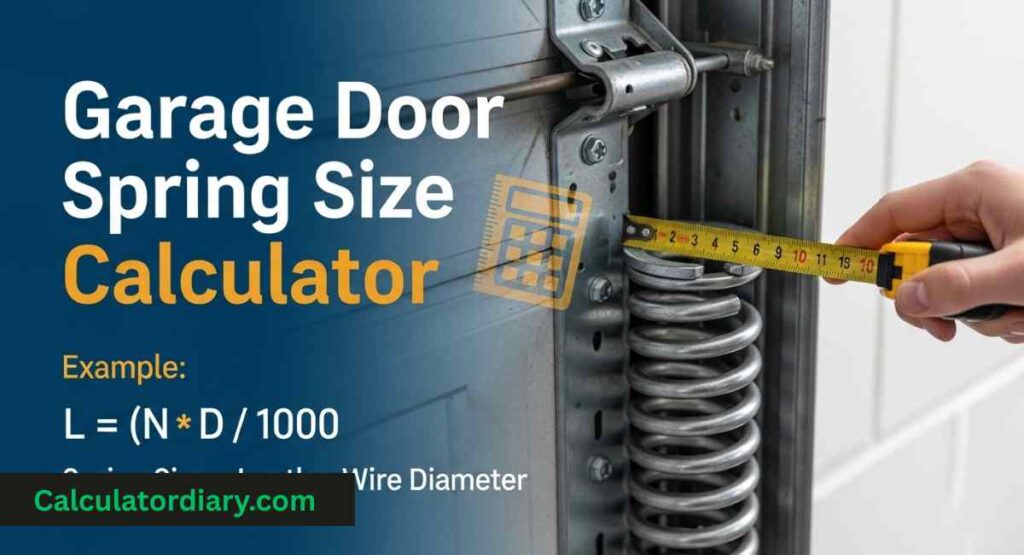
- Inside Diameter (ID): Measure across the center of the spring’s coil. Common sizes are 1.75″ or 2″.
- Wire Size: Measure the thickness of the steel wire itself.
- Length: Measure the spring from end to end, but do not include the cones (the winding components at each end).
- Wind Direction: Note if the coil is left-wound or right-wound (this will be indicated on the spring).
Measuring Extension Springs: Length, Diameter, and Strength
- Length: Measure the spring from hook to hook when it is in a relaxed (un-stretched) state.
- Diameter: Measure the width of the coil.
- Color Code: Many have a color-coded tag indicating strength (e.g., yellow, red, blue).
Deciphering Your Calculator’s Results: Key Spring Specifications Explained
- Wire Size (Gauge): A thicker wire (lower gauge number) indicates a stronger spring.
- Inside Diameter (ID): Must match your existing shaft and winding cones.
- Spring Length: The total coiled length required to counterbalance your door’s weight.
- Quantity of Springs: Most residential doors over 10 feet tall or made of heavy materials require two torsion springs for balance and safety.
- Cycle Life Rating: A 10,000-cycle spring will last about 7-10 years with normal use; a 25,000-cycle spring is a long-life investment.
- IPPT (Inch-Pounds Per Turn): This tells you how much torque the spring provides with each winding turn during installation.
Safety First: DIY vs. Professional Spring Replacement
When to Consider DIY: A Realistic Assessment of Your Skills
Only attempt this if you are highly experienced with mechanical repairs, understand the risks of high-tension systems, and have a helper.
The Essential Tools: Winding Bars and Other Safety Equipment
For torsion springs, you MUST use the correct, sturdy steel winding bars. Never use a screwdriver. Safety glasses are non-negotiable.
When to Call a Professional: Recognizing Limitations and High-Risk Situations
If you have any doubt, call a pro. This is especially true for two-spring systems, high-lift conversions, or if you lack the specific tools and knowledge. The risk of severe injury is significant.
How often should garage door springs be replaced? (Spring Cycle Life)
Most residential springs last 10k–20k cycles (about 7–12 years for average use). Upgrade to higher‑cycle springs for longer life.
Can I replace just one torsion spring? (Spring Qty)
Replace both on a two‑spring system. Mixing new and old springs makes balancing difficult and shortens overall life.
What are the signs of a broken or failing garage door spring?
Gap in the coil, loud bang, door heavy/hard to lift, opener straining or stopping, cables loose or off the drum.
Does the garage door opener compensate for incorrect spring size? (Garage Door Opener)
Only partially. The opener is not a lift device; it moves a balanced door. Mis‑sized springs burn out openers fast.
How do I know if my garage door is balanced? (Garage Door Balance)
With opener disconnected, lift to waist height. A balanced door stays put with light fingertip force up or down.
What if I can’t find my old spring’s measurements?
Weigh the door (use a bathroom scale under a lifted, clamped door or a pull scale) and enter size/lift details into the calculator. It will suggest new specs.
How do torsion springs and extension springs differ in sizing calculations?
Torsion sizing centers on IPPT, drum radius, and turns. Extension sizing is based on door weight, stretch at closed position, and spring rate with safety cables.