
Key Takeaways
- A 3-5kg laying hen eats roughly 100-130g of feed per day, while broilers need 50-180g/day depending on age and target weight
- Feed costs make up 60-70% of total poultry raising expenses, so accurate calculation directly protects your profit margin
- Crude protein requirements shift by stage: starter feed (20-24% protein), grower feed (16-18%), and layer feed (16-18% with added calcium for shell strength)
- Use the calculator below to get exact daily and weekly feed quantities in kg based on your flock size, bird type, and age
Quick Answer
A chicken feed calculator works by taking your bird count, breed type (layer, broiler, or dual-purpose), age in weeks, and target body weight, then applying standard feed conversion ratios to output daily and weekly feed needs in kg. For a flock of 10 laying hens, expect roughly 1-1.3kg of feed per day total during peak lay.
What Is a Chicken Feed Calculator and How Does It Work
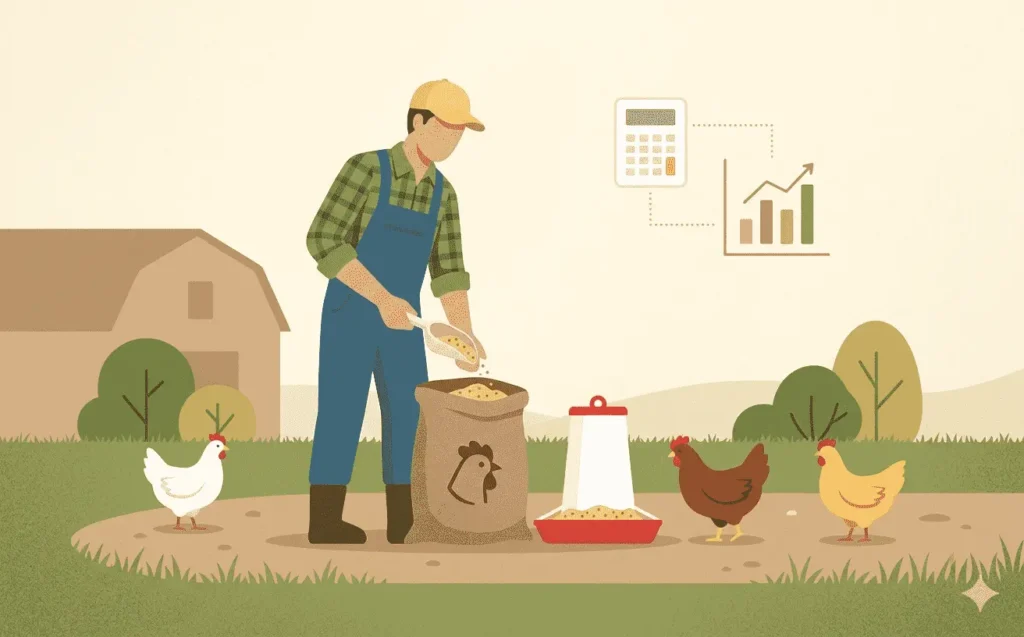
A chicken feed calculator takes the guesswork out of feeding your flock. Instead of eyeballing scoops and hoping you’re not overfeeding (wasting money) or underfeeding (stunting growth and dropping egg production), the calculator uses a few simple inputs to give you a precise daily feed amount.
The main inputs are:
- Bird type: layer, broiler, or dual-purpose breed
- Age in weeks: feed needs change dramatically from chick to adult
- Current or target weight: heavier birds eat more, broilers especially
- Number of birds: scales the per-bird amount to your whole flock
- Feed type/stage: starter, grower, finisher, or layer feed
How Feed Conversion Ratio (FCR) Affects Results
Feed Conversion Ratio (FCR) is the amount of feed (in kg) a bird needs to consume to gain 1kg of body weight. A broiler with an FCR of 1.7 needs 1.7kg of feed to put on 1kg of weight. Lower FCR means more efficient growth and less money spent per kg of meat produced.
For layers, FCR is measured differently — typically as kg of feed per dozen eggs or per kg of egg mass. A well-managed flock averages around 2-2.2kg of feed per dozen eggs.
How Much to Feed Chickens Per Day in KG
Here’s a breakdown by bird type and growth stage. These figures are averages — actual intake varies with breed, climate, and activity level (free-range birds often eat slightly less commercial feed because they forage).
Layer Hens (per bird/day)
| Age/Stage | Feed Amount | Feed Type | Crude Protein |
|---|---|---|---|
| 0-6 weeks (chick) | 15-40g, increasing weekly | Starter feed | 20-22% |
| 7-18 weeks (grower) | 50-90g | Grower feed | 16-18% |
| 18+ weeks (laying) | 100-130g | Layer feed | 16-18% + calcium |
Broiler Chickens (per bird/day)
| Week | Feed Amount | Feed Type | Crude Protein |
|---|---|---|---|
| Week 1 | 15-20g | Starter | 22-24% |
| Week 2-3 | 40-70g | Starter/Grower | 20-22% |
| Week 4-5 | 100-140g | Grower | 18-20% |
| Week 6+ | 150-180g | Finisher | 16-18% |
Free-Range / Backyard Birds
Free-range chickens that forage actively for bugs, grain, and greens may only need 70-100g of supplemental feed per day once mature, since 20-30% of their nutritional needs come from natural sources. Don’t cut their feed too aggressively though — foraging is unpredictable, and birds need a consistent baseline to maintain steady egg production.
Poultry Feed Chart by Age and Breed
Layer Feeding Chart (Week by Week)
Layers move through three clear nutrient phases:
- Starter (0-6 weeks): highest protein for rapid early growth, around 20-22% crude protein
- Grower (7-18 weeks): protein drops slightly to 16-18%, focus shifts to frame development
- Layer (18 weeks onward): protein stays at 16-18%, but calcium jumps significantly — layer feed typically includes oyster shell or limestone for eggshell strength
Broiler Feeding Chart (Week by Week)
Broilers are bred for fast weight gain, so their feed transitions happen quickly:
- Starter (0-2 weeks): 22-24% protein, finely ground crumbles
- Grower (3-4 weeks): 20-22% protein, pellets begin
- Finisher (5-6+ weeks): 16-18% protein, focus on weight gain efficiency over muscle development
Dual-Purpose / Backyard Breed Chart
Dual-purpose breeds (Rhode Island Red, Sussex, Plymouth Rock) grow slower than broilers and need less aggressive protein scaling. A simple starter-to-grower-to-layer transition at roughly 0-8, 8-18, and 18+ weeks works well for most backyard flocks.
How to Calculate Feed Requirements Manually (Formula Method)
If you want to formulate or calculate feed without a tool, here’s the basic process:
Step 1: Determine your flock’s average daily feed need per bird (use the charts above based on age/type)
Step 2: Multiply by your total bird count
Formula: Feed per bird/day × Number of birds = Total daily feed
Step 3: Multiply daily total by 7 for weekly feed, or by 30 for monthly
Worked example:
You have 20 laying hens at 120g/day each.
- Daily: 20 × 120g = 2,400g = 2.4kg/day
- Weekly: 2.4kg × 7 = 16.8kg/week
- Monthly: 2.4kg × 30 = 72kg/month
Calculating Feed Cost Per Bird/Batch
Take your monthly feed total in kg and multiply by your local feed price per kg. If layer feed costs ₹35/kg and you need 72kg/month, that’s ₹2,520/month for 20 hens — roughly ₹126 per bird, per month, just for feed.
Broiler Chicken Feed Calculator – Specific Guidance
Feed Quantity by Target Slaughter Weight
| Target Weight | Approx. Total Feed Needed | Typical Days to Reach |
|---|---|---|
| 1.5kg | 2.4-2.7kg per bird | 28-32 days |
| 2.0kg | 3.2-3.6kg per bird | 35-40 days |
| 2.5kg | 4.2-4.6kg per bird | 42-45 days |
FCR Benchmarks for Broilers
The poultry industry standard FCR for modern broiler breeds ranges from 1.6 to 1.8. If your birds are consuming significantly more feed than this ratio suggests for their weight gain, check for feed wastage, poor-quality feed, disease, or overcrowding — all of which push FCR higher and cut into profit.
Example scenario: A small farm raising 50 broilers to 2kg average weight, with an FCR of 1.7, will need approximately 170kg of total feed across the grow-out period (50 birds × 2kg × 1.7).
Meat Chicken vs Layer Feed Requirements – Key Differences
| Factor | Broiler/Meat Chicken | Layer Hen |
|---|---|---|
| Protein level | Higher (18-24%) | Moderate (16-18%) |
| Calcium content | Low to moderate | High (3.5-4.5%) for shell formation |
| Feeding duration | 5-8 weeks total | Year-round, 18+ weeks onward |
| Total feed/bird | 2.4-4.6kg lifetime | 100-130g daily, ongoing |
| Growth priority | Rapid muscle gain | Sustained egg production |
Factors That Affect Feed Consumption
Climate and Season
Birds eat more in cold weather to maintain body heat, sometimes 10-15% more than in moderate temperatures. In hot climates, intake drops, but water consumption rises sharply — monitor both together.
Breed and Genetics
Commercial hybrid layers (like ISA Brown or Lohmann Brown) are bred for high feed efficiency and consistent intake. Heritage and dual-purpose breeds often have slightly higher FCR but better foraging ability, which can offset feed costs in free-range setups.
Housing and Management Practices
Feeder design matters more than most farmers realize. Open trough feeders can waste 10-20% of feed through spillage and contamination. Switching to tube or trough feeders with lips, and raising feeders to chest height of the bird, cuts wastage significantly.
Tips to Reduce Feed Wastage and Cost
- Use the right feeder height — adjust so the feed lip sits level with the bird’s back to minimize spillage
- Store feed properly — keep in sealed containers away from moisture to prevent mold and nutrient loss
- Mix in locally available ingredients — wheat, barley, millet, and sunflower meal can supplement commercial feed if balanced correctly for protein and amino acid content
- Avoid overfilling feeders — fill to one-third capacity to reduce scratching and waste
- Add grit and oyster shell separately — don’t mix into feed; offer free-choice so birds take only what they need
- Track feed-to-egg or feed-to-weight ratio monthly — catch inefficiencies early before they compound
Homemade Chicken Feed Recipe: Formulating Your Own Mix
If you want to formulate a custom feed using locally sourced grains, here’s a basic balanced ratio for layer hens (16-17% crude protein):
- Maize/corn: 45-50%
- Wheat or rye: 10-15%
- Soybean meal or legume meal: 20-25% (primary protein and amino acid source)
- Rice bran or wheat bran: 5-10%
- Oyster shell/limestone: 4-5% (calcium for shell strength)
- Vitamin-mineral premix: 1-2%
- Optional: flax seed (omega-3 boost), sunflower seed, or dried bugs as a natural protein/insect-based supplement for free-range flocks
Building a spreadsheet with columns for each ingredient, its protein and fat content, cost per kg, and percentage in your mix lets you adjust the formula and instantly see how total protein and cost shift — useful for comparing organic vs conventional ingredient sources.
How much feed does a chicken need per day in kg?
On average, a laying hen needs 0.1-0.13kg (100-130g) of feed daily, while broilers need anywhere from 0.05kg to 0.18kg depending on their age and growth stage. Free-range birds may need slightly less supplemental feed.
How do I calculate feed for 100 broiler chickens?
Multiply the daily feed amount per bird (based on their current week) by 100. For example, at week 4 with 120g/day per bird, 100 birds need 12kg of feed daily, or 84kg weekly.
What is a good FCR for broiler chickens?
A good FCR for modern broiler breeds is between 1.6 and 1.8, meaning 1.6-1.8kg of feed produces 1kg of weight gain. Anything significantly higher suggests management issues like wastage, disease, or poor feed quality.
How much does it cost to feed a chicken per month?
For a layer hen consuming around 3.6-4kg of feed per month, monthly cost depends on local feed prices, but typically ranges from ₹100-150 per bird in most regions. Broilers cost more per month since they’re consuming larger quantities during their short grow-out period.
Do layers need different feed than broilers?
Yes. Layer feed has higher calcium content (3.5-4.5%) to support eggshell formation, while broiler feed prioritizes higher protein levels for rapid muscle growth. Feeding layer feed to broilers or vice versa can affect growth rates and egg quality.
How much feed is needed for 1kg weight gain in broilers?
Based on standard FCR of 1.6-1.8, you’ll need 1.6-1.8kg of feed to produce 1kg of body weight gain in broiler chickens.
Is a chicken feed calculator free to use?
Yes, the calculator on this page is completely free. Simply enter your bird type, age, and flock size to get instant daily and weekly feed estimates in kg.