
If you have ever tried adding 2½ cups of flour to 1¾ cups of sugar while following a recipe, you already know how confusing mixed number problems can feel. Most people reach for a calculator, only to find that basic calculators do not handle fractions well at all. That is exactly where a dedicated Mixed Numbers Calculator makes your life easier.
This free AI Mixed Number Calculator handles every arithmetic operation you need, including addition, subtraction, multiplication and division of mixed numbers. It delivers step by step solutions so you do not just get an answer but actually understand how the math works. Whether you are a student working through homework, a teacher preparing examples, a carpenter measuring cuts or a home cook scaling a recipe, this tool was built for you.
In this guide you will learn what mixed numbers are, how to use this calculator, how to perform every operation manually, and how to avoid the most common mistakes people make during the conversion process.
What is a Mixed Numbers Calculator?
A Mixed Numbers Calculator is an online math tool that performs arithmetic operations on mixed numbers, including addition, subtraction, multiplication and division, and returns simplified results along with step by step explanations.
Unlike a Basic Math Calculator that only works with whole numbers or decimals, a Mixed Fraction Calculator understands the structure of numbers like 3½ or 7¾ and processes them correctly using advanced algorithms built specifically for fraction arithmetic.
This calculator also functions as an Improper Fraction Calculator and a Fraction to Decimal Calculator, making it a complete tool for all fraction related math calculations.
What this calculator does:
- Adds, subtracts, multiplies and divides mixed numbers
- Converts mixed numbers to improper fractions automatically
- Finds the least common denominator when needed
- Simplifies the resulting fraction using the greatest common factor
- Shows full step by step explanations for every problem
- Handles decimal to mixed number conversions
- Supports converting mixed numbers back to decimals
What Are Mixed Numbers?
Defining Mixed Numbers
A mixed number is a number that combines a whole number and a proper fraction written together. For example, 2¾ means two whole units plus three fourths of another unit. The whole number part and the fraction part together represent one single value.
Every mixed number has three parts. The first is the whole number, the second is the numerator of the fraction, and the third is the denominator of the fraction. In the number 5⅔, the whole number is 5, the numerator is 2 and the denominator is 3.
Mixed Numbers vs Improper Fractions
These two forms represent the same value but look different. Understanding both is important because manual calculations and this Fraction Calculator often require converting between them.
| Form | Example | Meaning |
|---|---|---|
| Mixed Number | 2¾ | 2 whole units and ¾ of one more |
| Improper Fraction | 11/4 | 11 parts where each whole has 4 parts |
| Decimal | 2.75 | Same value with a decimal point |
An improper fraction has a numerator larger than its denominator. A mixed number says the same thing in a more readable way. Most people find mixed numbers easier to picture in real life while improper fractions are easier to use in manual calculations.
When Do We Use Mixed Numbers in Real Life?
Mixed numbers appear constantly outside of a classroom. Here are the most common situations:
Cooking and baking: Recipes regularly call for 1½ teaspoons of vanilla or 2¾ cups of milk. The mixed number format makes it easy to measure with standard kitchen tools.
Carpentry and construction: A wood plank measured at 6⅜ inches needs to be cut precisely. Builders and carpenters work with mixed numbers every single day.
Medical dosages: A patient may need 1½ tablets of a medication or a dose of 2¼ milliliters of a liquid.
School and education: Mixed numbers are introduced in Grade 4 according to Common Core mathematics standards and remain a core part of arithmetic through middle school.
Sewing and fabric work: Patterns frequently require measurements like 3½ yards of fabric or 1¼ inch seam allowances.
How to Use This Mixed Numbers Calculator
Follow these steps to get instant step by step solutions for any mixed number problem.
Step 1: Locate the first input field and enter your whole number, then enter the numerator and denominator of the fraction part separately.
Step 2: Select the math operation you want to perform. Choose from addition, subtraction, multiplication or division using the operation selector.
Step 3: Enter the second mixed number the same way you entered the first, with whole number, numerator and denominator in their respective fields.
Step 4: Click the Calculate button to process your math calculation.
Step 5: Read your result. The calculator shows the final simplified answer as a mixed number along with complete step by step explanations so you can follow the full process.
Tip: If you are working with a whole number rather than a mixed number, simply enter 0 as the fraction part. The calculator handles whole number inputs without any issues.
Adding Mixed Numbers
Manual Method
Adding mixed numbers manually requires finding a common denominator before the fractions can be combined. Here is the full process.
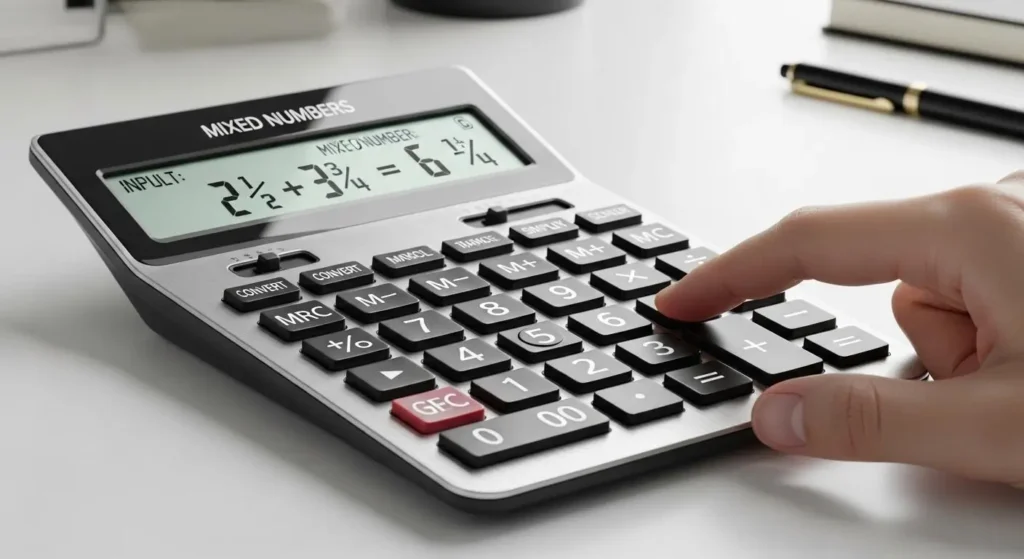
Example: 2½ + 3¾
First, identify the denominators. The first fraction has a denominator of 2 and the second has a denominator of 4. The least common denominator of 2 and 4 is 4.
Second, convert the first fraction so it uses the common denominator. Multiply the numerator and denominator of ½ by 2 to get 2/4.
Third, rewrite the problem as 2(2/4) + 3(3/4).
Fourth, add the whole numbers together. 2 plus 3 equals 5.
Fifth, add the numerators. 2 plus 3 equals 5, so the fraction part becomes 5/4.
Sixth, since 5/4 is an improper fraction, convert it. 5 divided by 4 equals 1 remainder 1, so 5/4 becomes 1¼.
Seventh, add this to your whole number total. 5 plus 1¼ equals 6¼.
The answer is 6¼.
Using the Adding Fractions Calculator
Enter 2, 1 and 2 for the first mixed number. Select the addition operation. Enter 3, 3 and 4 for the second. Click Calculate and the tool instantly returns 6¼ with every step shown.
Common Mistake
The most frequent error when adding mixed numbers is forgetting to find the least common multiple of the denominators before adding. Adding ½ and ¾ directly as if the denominators were the same gives a wrong answer every time.
Subtracting Mixed Numbers
Manual Method
Example: 5¾ minus 2½
First, find the least common denominator of 4 and 2. The least common denominator is 4.
Second, convert ½ to 2/4 so both fractions share the same denominator.
Third, rewrite as 5(3/4) minus 2(2/4).
Fourth, subtract the fraction parts. 3/4 minus 2/4 equals 1/4.
Fifth, subtract the whole numbers. 5 minus 2 equals 3.
The answer is 3¼.
Borrowing in Subtraction
When the fraction you are subtracting is larger than the fraction you are subtracting from, you need to borrow from the whole number. For example, in 4¼ minus 1¾, the fraction ¾ is larger than ¼. Borrow 1 from the 4, convert it to 4/4, and add it to ¼ to get 5/4. Now subtract 3/4 from 5/4 to get 2/4, which simplifies to ½. Subtract the whole numbers: 3 minus 1 equals 2. The answer is 2½.
Common Mistake
Borrowing errors are the most common problem in mixed number subtraction. Always check whether the fraction being subtracted is larger before you begin so you know whether borrowing is needed.
Multiplying Mixed Numbers
Manual Method
Multiplying mixed fractions is different from adding or subtracting. You do not need a common denominator. Instead, convert everything to improper fractions first and then multiply straight across.
Example: 2½ × 1¾
First, convert 2½ to an improper fraction. Multiply 2 by 2 and add 1 to get 5. Write it as 5/2.
Second, convert 1¾ to an improper fraction. Multiply 1 by 4 and add 3 to get 7. Write it as 7/4.
Third, multiply the numerators. 5 times 7 equals 35.
Fourth, multiply the denominators. 2 times 4 equals 8.
Fifth, the result is 35/8. Convert back to a mixed number using long division. 35 divided by 8 equals 4 remainder 3. The answer is 4⅜.
Sixth, check whether the fraction can be simplified. The greatest common factor of 3 and 8 is 1, so the fraction is already in its simplest form.
Common Mistake
The biggest error with multiplying mixed numbers is trying to multiply the whole number parts and fraction parts separately. This gives the wrong answer. Always convert to improper fractions first before you multiply.
Dividing Mixed Numbers
Manual Method
Division of mixed numbers uses the same first step as multiplication. Convert to improper fractions, then multiply by the reciprocal of the second fraction.
Example: 3½ ÷ 1¼
First, convert 3½ to an improper fraction. 3 times 2 plus 1 equals 7. Write 7/2.
Second, convert 1¼ to an improper fraction. 1 times 4 plus 1 equals 5. Write 5/4.
Third, flip the second fraction to get its reciprocal. 5/4 becomes 4/5.
Fourth, multiply 7/2 by 4/5. Multiply numerators: 7 times 4 equals 28. Multiply denominators: 2 times 5 equals 10.
Fifth, the result is 28/10. Find the greatest common divisor of 28 and 10, which is 2. Divide both by 2 to simplify the resulting fraction to 14/5.
Sixth, convert 14/5 to a mixed number using long division. 14 divided by 5 equals 2 remainder 4. The answer is 2⅘.
Common Mistake
People often flip the wrong fraction. Always flip the second number, the one you are dividing by, never the first. Division by zero is also something to watch for. If any denominator in your problem is 0, the calculation is undefined.
How to Add a Fraction by a Whole Number
To add a fraction to a whole number, convert the whole number to a fraction by writing it over 1, then find a common denominator and add normally.
Example: ¾ + 2
Write 2 as 2/1. The common denominator of 4 and 1 is 4. Convert 2/1 to 8/4. Add 3/4 and 8/4 to get 11/4. Convert to a mixed number: 11 divided by 4 equals 2 remainder 3. The answer is 2¾.
This same process applies when you are asking how do you add a fraction by a whole number in any context, whether it is a recipe, a measurement or a math problem.
Conversions
Mixed Numbers to Improper Fractions
Multiply the whole number by the denominator. Add the numerator. Place the result over the original denominator.
For 3⅔: multiply 3 by 3 to get 9, add 2 to get 11, place over 3. Result is 11/3.
Improper Fractions to Mixed Numbers
Divide the numerator by the denominator using long division. The quotient is your whole number. The remainder is your new numerator. Keep the same denominator.
For 17/5: 17 divided by 5 equals 3 remainder 2. Result is 3⅖.
Decimal to Mixed Number
To convert a decimal to a mixed number, separate the whole number from the decimal part. Convert the decimal part to a fraction by placing it over the appropriate power of 10, then simplify using the greatest common factor.
Example: 2.75
The whole number is 2. The decimal part is 0.75. Write 75/100. The greatest common factor of 75 and 100 is 25. Divide both by 25 to get 3/4. The answer is 2¾.
This conversion process is one of the most searched topics related to mixed number math, and this Fraction Calculator handles it automatically.
Mixed Number to Decimal
Divide the numerator of the fraction by the denominator and add the result to the whole number.
For 1¾: 3 divided by 4 equals 0.75. Add 1 to get 1.75.
Simplifying Mixed Numbers
After any math operation, always check whether the fraction part can be simplified. Find the greatest common factor of the numerator and denominator. Divide both by that number.
For 6/8: the greatest common factor is 2. Divide both by 2 to get 3/4. A result of 6 and 6/8 simplifies to 6¾.
If the numerator of the fraction part is larger than the denominator after your calculation, convert it to a whole number or mixed number and add it to the existing whole number portion of your answer.
Common Mistakes When Working with Mixed Numbers
Not converting before multiplying or dividing: Always convert mixed numbers to improper fractions before you multiply or divide. Skipping this step is the most common source of wrong answers.
Ignoring the least common denominator: When adding or subtracting, fractions must share a common denominator. Finding the least common multiple of the denominators first prevents errors.
Forgetting to simplify: Many students stop at a correct but unsimplified answer. Always check the greatest common divisor of your numerator and denominator and simplify the resulting fraction.
Borrowing mistakes in subtraction: Always check whether borrowing is needed before subtracting fraction parts.
Division by zero: A denominator of 0 makes any fraction undefined. Always check your inputs before calculating.
Why Use a Calculator vs Manual Method
| Situation | Best Approach |
|---|---|
| Exam or test | Manual calculation |
| Homework practice | Manual first, then verify with calculator |
| Real life cooking or building | Calculator for speed |
| Teaching a student | Manual with step by step explanations |
| Bulk or repeated calculations | Calculator always |
Manual calculations build understanding. The Mixed Number Calculator builds speed and confidence. Both have their place.
Related Calculators
These Fractions Calculators work alongside the Mixed Numbers Calculator for complete fraction math coverage:
Fraction Calculator handles simple fractions without whole number parts.
Improper Fraction Calculator converts and calculates with top heavy fractions.
Adding Fractions Calculator focuses specifically on fraction addition with full steps.
Fraction to Decimal Calculator converts any fraction to its decimal equivalent instantly.
Decimals to Fractions reverses the conversion process from decimal point values.
Convert Percent to Fraction translates percentage values into fraction form.
Unit Rate Calculator helps with ratio and rate problems that involve fractions.
Basic Math Calculator for simple whole number arithmetic operations.
Population Standard Deviation Calculator for statistics that involve fractional values.
Pipe Flow Calculator and Pipe Pressure Calculator for engineering calculations where fractional measurements appear in formulas.
Physics Calculator for science problems that involve fractions in formulas.
Glossary of Mixed Number Terms
Mixed Number: A number combining a whole number and a proper fraction, such as 3½.
Improper Fraction: A fraction where the numerator is greater than the denominator, such as 7/2.
Common Denominator: A shared denominator between two or more fractions that allows them to be added or subtracted.
Least Common Denominator: The smallest common denominator possible, found using the least common multiple of the denominators.
Least Common Multiple: The smallest number that is a multiple of two given numbers.
Greatest Common Factor: The largest number that divides evenly into both the numerator and denominator, used to simplify the resulting fraction.
Greatest Common Divisor: Another term for greatest common factor, used interchangeably in the simplification process.
Numerator: The top number in a fraction.
Denominator: The bottom number in a fraction.
Reciprocal: The flipped version of a fraction, used in division. The reciprocal of 3/4 is 4/3.
Simplify: To reduce a fraction to its lowest terms using the greatest common factor.
Decimal Part: The digits after the decimal point in a number like 2.75.
Conclusion
Mixed number arithmetic does not have to be frustrating. Whether you are adding mixed numbers for a recipe, multiplying mixed fractions for a construction project or working through school problems, understanding the process makes every calculation manageable.
This Mixed Numbers Calculator gives you instant answers with complete step by step explanations so you build real understanding alongside speed. Use the manual methods in this guide to strengthen your skills and use the calculator to verify your work and save time when it matters.
Try the calculator above and solve your first mixed number problem in seconds.
How do you add mixed numbers step by step?
Find the least common denominator of the two fractions. Convert both fractions to use that denominator. Add the whole numbers together. Add the numerators together while keeping the denominator the same. Simplify the resulting fraction if needed. If the fraction part is improper, convert it and add it to the whole number.
How do I rewrite a decimal in mixed fraction notation?
Separate the whole number from the decimal part. Write the decimal digits as the numerator over the correct power of 10. For 3.25, write 25/100. Find the greatest common factor of 25 and 100, which is 25. Divide both by 25 to get 1/4. The final answer is 3¼.
What is the point of mixed fractions?
Mixed fractions make quantities easier to understand in real life. Saying a board is 6⅜ inches long is more meaningful than saying it is 51/8 inches. Mixed numbers communicate size more naturally than improper fractions and more precisely than rounded decimals.
How to put mixed fractions in a scientific calculator?
Most scientific calculators have a fraction button labeled a b/c or F D. Press the whole number, then the fraction button, then the numerator, then the fraction button again, then the denominator. The display will show the mixed number format depending on the calculator model.
Why is it helpful to convert mixed numbers into fractions when doing calculations?
Improper fractions are simpler to work with during multiplication and division because you only need to multiply or divide two numbers straight across. Mixed numbers require extra steps if not converted first, which increases the chance of errors during manual calculations.
Can you multiply mixed numbers without converting to improper fractions?
Technically yes, but it requires applying the distributive property across both parts, which is significantly more complex and error prone. Converting to improper fractions first is the universally recommended method for multiplying mixed fractions.
What is the difference between a mixed number and an improper fraction?
Both represent the same value. A mixed number shows the whole number and fraction parts separately, like 2¾. An improper fraction shows the total as a single fraction, like 11/4. The conversion process between them is straightforward in both directions.